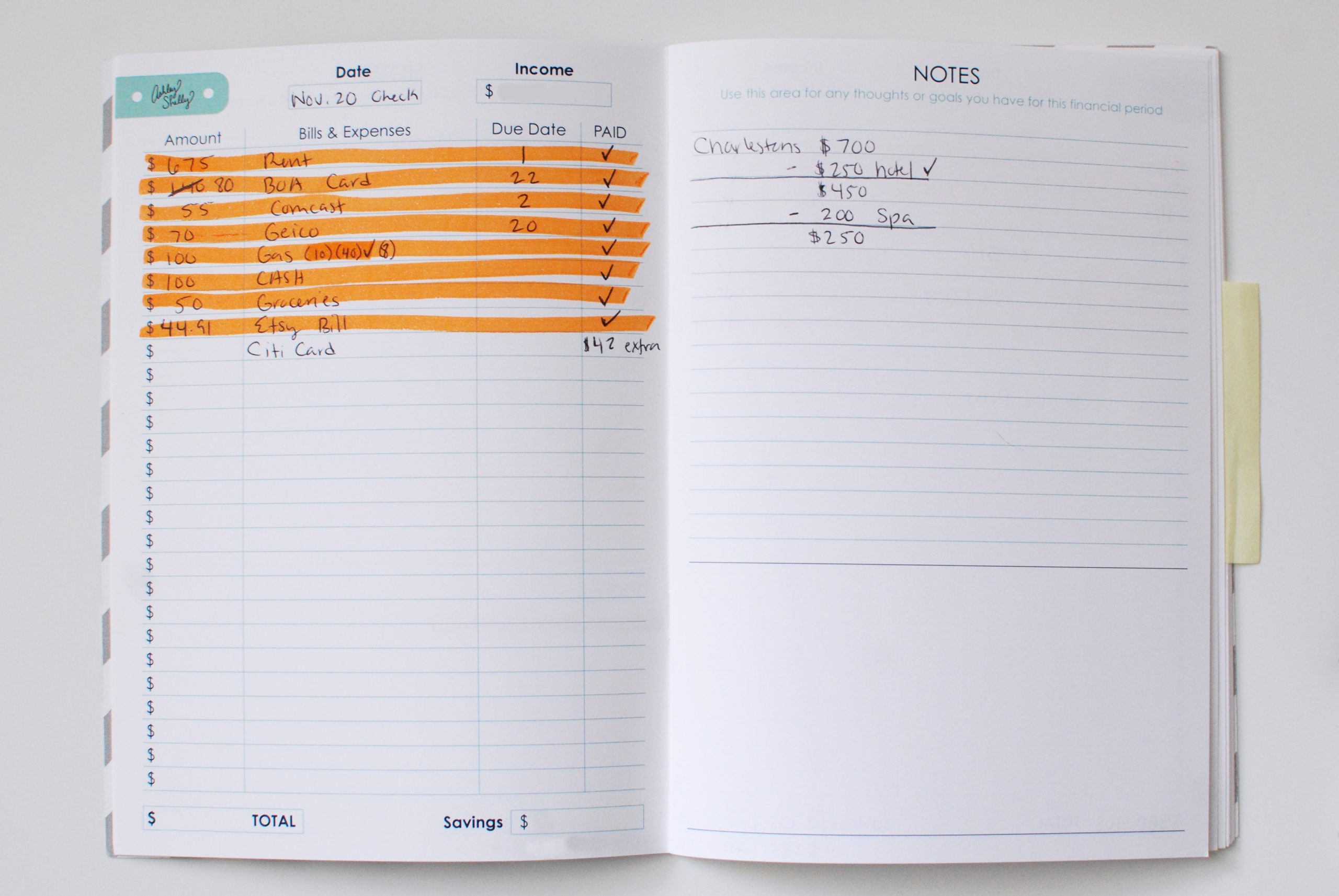

Category: Action Steps

  • Where Did My Money Go? Why You Need a Budget in Your 20s

    Where Did My Money Go? Why You Need a Budget in Your 20s

    Be honest, have you ever opened your bank app and thought, “Wait… where did all my money go?”

    It happens to the best of us. But here’s the truth: when you wing it with your money, you accidentally give your dollars permission to disappear. Winging it almost always leads to overspending, often without you even realizing it.

    Budgeting may sound about as exciting as studying for a Chem exam, but it’s one of the most important and practical steps you can take with your money. And the best part? You have the power to make it happen.

    A budget is a powerful tool that helps you gain control over your finances. When you have a plan, every dollar has a purpose, and that purpose moves you closer to your goals instead of further away.

    Budgeting allows you to clearly see how much money you need to invest, pay your bills, and even set aside for fun. Teens might be able to slide by without budgeting, but if you’re in your 20s, one of the real secrets to long-term financial confidence and success is building the discipline of creating a budget and sticking to it.

    A budget doesn’t restrict you. It gives you freedom. Freedom to spend intentionally. Freedom to save strategically. Freedom to feel peace about your financial future.

    Proverbs 21:5 says, “The plans of the diligent lead to profit as surely as haste leads to poverty.” In other words, when you make a plan for your money and follow through with discipline, you’re far more likely to see positive results. But if you wing it and hope for the best, you may end up holding your breath the next time you swipe your card at Walmart.

    Side note: If you want a masterclass in wisdom, try reading one chapter of Proverbs each day. The financial insight is pure gold!

    Let me help you get started with a simple, faith-based money plan that works for your life, not against it (and no, it doesn’t require giving up your iced coffee)!

    Watch this video to learn how to stop winging it and start feeling confident with your money:
    [How to Stop Winging It With Your Money]

    To access the moveHER Money Budget Sheet used in the video, click here.

    You can’t control every part of life, but you can choose to plan your money with purpose. And when you do, peace follows.


  • Fresh Starts

    Fresh Starts

    Today marks the first day of spring. And if you’re anything like me, that’s worth celebrating.

    I am not a cold-weather person. Winter has its charm for about… ten minutes. After that, I’m counting the days until the sun feels warm again and the world wakes up.

    One of my favorite moments each year is seeing the first daffodils push through the soil. After months of frozen ground and gray skies, those little yellow blooms feel like a quiet announcement: hope is back. Soon the birds start singing again, the trees begin to blossom, and the grass slowly turns green. Everywhere you look, life is starting over.

    Spring has a way of reminding us that new beginnings are always possible.

    The Bible captures this beautifully in Isaiah 43:19:

    “See, I am doing a new thing! Now it springs up; do you not perceive it?”

    Just like the earth gets a fresh start each spring, this season is a perfect time to give your finances a fresh start too.

    Think of it as spring cleaning for your financial life.

    Maybe over the winter a few spending habits crept in that you’d like to change. Maybe you’ve been meaning to start a budget but haven’t quite taken the first step yet. Or maybe you just want to feel more in control of your money instead of wondering where it all went at the end of the month.

    Spring is a great time to brush the dust off your finances.

    Take a fresh look at your spending. Rework your budget or start one for the first time. Small changes made now can grow into something strong and steady over time, just like those first daffodils in the garden.

    If you’re not sure where to begin, access the Money Budget Sheet from moveHer Money: click here.

    (The link will direct you to make a personal copy of the Budget Sheet for yourself. Just click “make copy” and you’ll have a private version of the moveHER Money Budget Sheet!)

    After all, new seasons are made for new beginnings. Your finances can bloom too. 🌱

  • Giving on a College Budget: Start Before You Feel Ready

    Giving on a College Budget: Start Before You Feel Ready

    The other week, I was scrolling through Instagram when I saw a reel from a financial influencer I follow. Her advice stopped me dead in my tracks. Normally, she shares tips on budgeting and investing, showing us her budget breakdowns; everything from rent and food to “fun” expenses like eating out, makeup, Botox, and bi-weekly shellac manicures.

    But this time, she shared something that really made me think: she added a giving category to her budget. My first thought was, “Wait, she wasn’t giving before? If she could afford bi-weekly manicures and Botox, surely she could have afforded to be giving long ago!”

    It got me reflecting on a money masterclass I’d attended a couple of months ago, hosted by two women with over 450K followers on Instagram and a thriving membership program. The class covered budgeting in detail, yet giving wasn’t even mentioned. As I explored more financial influencers and programs, I realized this was a common theme…multiple people in the financial space who do not talk about giving.

    Here’s the thing: If you wait until you’re “making enough money” to give, you might never give at all, or you’ll delay it far too long.

    I get it! When I first started my career in Atlanta, I worked full-time and served tables on nights and weekends just to pay bills and my car loan (By the way, never get a car loan—it’s one of the worst financial decisions you can make!). During that time, I could barely afford to give more than $5 or $10 at church. My mindset was, “I can’t afford to give more right now.”

    Then, I moved to NYC. This included not only a raise in pay but also in living expenses. Once again, I thought, “When I have more money, I’ll give more.” But after a year of living in NYC and attending church regularly, I decided to take a step and be more consistent in my giving. While I didn’t give the full 10% the Bible recommends, I started giving 5-7% of my income each month. And you know what? I didn’t go broke. In fact, I still had enough to pay my bills, save, and invest.

    As I transitioned into a sales role and began earning commissions, my income increased, and so did my giving. However, I won’t lie. It took a long time for me to become a “cheerful giver” (2 Corinthians 9:7-8). Giving hurt at first. My natural instinct was to hoard my paycheck, saving and investing every penny.

    But here’s the lesson I slowly learned: When you trust God with your money, it shows that He can trust you in return. Even when it hurts and you’re unsure if you’ll have enough, giving proves your faith.

    So, my encouragement to you today is this: Don’t always follow the advice of every influencer or money expert. Instead, take small steps toward trusting God with your finances. It’s a journey, and the rewards, both financial and spiritual, are worth it.

  • Money Mistakes to Fix in Your Twenties

    Money Mistakes to Fix in Your Twenties

    Let me guess…

    If you could hop in a time machine and visit your younger self, there’s at least one money decision you’d beg her not to make.

    (Probably more than one. It’s fine. We don’t judge here.)

    If that’s you, welcome to the club. We ALL make money mistakes. Some of them are small. Some of them are expensive. And some of them still make us cringe when we think about them.

    For example, here are a few financial lessons I learned the hard way:

    • I didn’t have an emergency fund and almost went completely broke after getting a flat tire during an internship in Atlanta. One pothole nearly ended my financial life.
    • I took out a car loan after college and paid hundreds of dollars in interest.
    • I was offered a 401(k) with a match after the company I worked for was acquired…and I didn’t take it. Why? Because I didn’t understand how a 401(k) worked, what a “match” meant, and it all felt way too complicated. (Ugh!)
    • And let’s not forget the time I loaned thousands of dollars to an ex-boyfriend and never saw that money again. 🤦🏼‍♀️

    I could keep going—but you get the point.

    Some money mistakes are just a bump in the road.
    Others? They can quietly set you back years.

    And if you’re in college, this matters more than you think.

    This is the time where you:

    • Build the money habits that shape your future
    • Decide whether you’ll live with financial peace or constant financial pressure
    • Make choices that impact your freedom, goals, and opportunities for years to come

    The problem? Most young adults were never actually taught how to manage money.

    So instead, they wing it. They make decisions that feel fine in the moment…and then deal with the stress, debt, and “I wish I would’ve known this sooner” moments later.

    That’s exactly why I created a free video to help change that.

    Inside Money Mistakes to Fix in Your 20s, you’ll learn:

    ✅ Two of the most common money mistakes young adults make (yes, the sneaky ones)

    ✅ Why they’re so easy to fall into

    ✅ And exactly how to fix them with confidence and clarity

    Because this isn’t about being perfect with money—it’s about being intentional.

    The sooner you take control of your finances, the sooner you’ll experience more freedom, peace, and options in your life.

    Also, if you want even more money tips and you’re ready to stop guessing and start making smarter money moves, check out my free guide: 8 Money Mistakes to Fix in Your 20s. This guide will provide all 8 mistakes people make in their twenties so you can start fixing them today (before they get more expensive)!

  • The Oversized Oops: Getting a Massive Dog Without Crunching the Numbers

    The Oversized Oops: Getting a Massive Dog Without Crunching the Numbers

    When I brought home my goldendoodle puppy, Lincoln, I was told he would grow to be about 60 to 65 pounds. Perfect size, they said. Manageable. Ideal first dog.

    Well… Lincoln had other plans.

    Somewhere along the way, it became clear my sweet puppy was actually the Shaquille O’Neal of the litter. Today, Lincoln weighs over 100 pounds. He’s tall, broad, and takes up most of the couch. People used to say, “Kindra, his paws are huge!” when he was little. I smiled and nodded, assuming all puppies had giant paws.

    They do not. That was a warning sign.

    And here’s the thing no one tells you when you get a dog, especially your first dog: bigger dog equals bigger expenses. Everywhere.

    Lincoln eats a lot. Dog food disappears at an impressive speed in our house. His medications cost more because doses are based on weight. When he stays at Alps Bark Park, he needs a suite upgrade because he literally doesn’t fit in a standard kennel. Vet care, grooming, and supplies all scale up with dog size.

    And then there are the expenses I didn’t even think about. Emergency vet visits. Boarding when I travel. Training. So much training. Toys and treats to keep his giant, intelligent doodle brain busy. Grooming appointments that take longer because there’s simply more dog.

    Looking back, I realize I skipped an important step. Jesus actually teaches about planning ahead in Luke 14:28–30:

    “Suppose one of you wants to build a tower. Won’t you first sit down and estimate the cost to see if you have enough money to complete it? For if you lay the foundation and are not able to finish it, everyone who sees it will ridicule you, saying, ‘This person began to build and wasn’t able to finish.’”

    In other words, count the cost first.

    I had never owned a dog before. I truly didn’t know what I was getting into. And financially? I definitely didn’t do the math.

    Here we are now. Lincoln is nine years old. He is the very best boy. The love of my life. Honestly, he’s the best ill-informed decision I’ve ever made.

    But let me be clear: he absolutely has his own line item in my budget. Multiple line items, actually. And he’s still expensive.

    So here’s my advice: always do the math before making a purchase, especially one that involves a living being who will be part of your life for many years. Take the time to have your Luke 14:28 moment. Pets aren’t short-term expenses. They’re long-term commitments of love, care, time, and money.

    Crunch the numbers. Think about food, vet care, training, boarding, and unexpected emergencies. Consider how your lifestyle and finances will support them over time.

    Because while Lincoln has been one of the greatest joys of my life, a little planning on the front end could have saved me a lot of unexpected financial stress along the way. He’s still worth every penny, but counting the cost first would have made the journey a lot easier.

  • How to Know if You’re Making the Wrong Financial Decision

    How to Know if You’re Making the Wrong Financial Decision

    We’ve all made money mistakes, and I’m definitely no exception.

    Let me share one of mine from my twenties, back when I was living in New York City and still figuring out adulthood, relationships, and money in real time.

    At the time, I was dating someone who was struggling financially. He was behind on bills and eventually asked me to loan him thousands of dollars to help him get back on his feet. When he first asked, I hesitated. Something in my gut told me to slow down and think it through.

    But instead of listening to that feeling, guilt took over. I didn’t want to seem unsupportive. I didn’t want to be “that girl.” And eventually, I said yes.

    Here’s the part that matters most:
    I didn’t tell anyone about the decision.

    Not my friends.
    Not my family.
    Not even my parents.

    Why? Because deep down, I knew it wasn’t a smart financial move, and I was embarrassed. I felt ashamed that I had ignored my better judgment, and I didn’t want anyone questioning my choice.

    A few weeks later, the weight of it all finally caught up to me. I called my dad and explained what had happened. He listened quietly, then said something I still remember to this day:

    “Sarah, why didn’t you talk to me before making this decision? I would have stopped you.”

    He was right. And, spoiler alert: I was never repaid.

    That experience taught me an expensive but invaluable lesson. One I wish I’d learned sooner.

    If you feel the need to hide a financial decision from the people you trust and respect most, that means you’re making the wrong choice.

    So let me ask you this:

    Is there anything financial happening in your life right now that you’re avoiding talking about?
    A credit card balance?
    A purchase you regret?
    A financial favor you agreed to out of pressure or guilt?

    Here’s the truth: everyone makes money mistakes, especially in their twenties. What matters most isn’t avoiding every mistake, it’s learning how to recognize them early and knowing when to ask for help.

    Talking openly with a trusted friend, family member, or mentor can help you gain perspective and prevent a small misstep from turning into a long-term setback.

    If you’re looking to be more proactive about your finances and avoid some of the most common money mistakes young adults make, I created a free resource called “8 Money Mistakes to Fix in Your Twenties.” It breaks down common financial missteps, like not asking for guidance, ignoring debt, or avoiding money conversations, and offers simple, practical steps you can take right now.

    You can download the free guide here:
    https://www.moveher.money/moneymistakes

    Consider this your nudge to take the next step…whether that’s starting a money conversation you’ve been avoiding or educating yourself so you can make more confident financial decisions moving forward.

    Pushing past embarrassment or shame could end up being one of the best financial decisions you make this year.

css.php
Hosted by Concordia University, Nebraska | CUNE Portal