“Nature, the mother of all things, has equipped brute animals with more means to fulfil the functions of their species; but to man alone she has given the faculty of reason, and so she has thrown the burden of human growth upon education. Therefore it is right to say that the beginning and the end, indeed the total sum of man’s happiness, are founded upon a good upbringing and education….A proper and conscientious instruction is the well-spring of all moral goodness. By contrast, the doors are flung wide open to folly and evil when education becomes corrupted and careless. Education is that special task which has been entrusted to us. This is why to other creatures nature has given swiftness of foot or wing, keeness of sight, strength or massiveness of body, coverings of wool or fur, or protection of scales, plates, horns, claws, or poisons, and has so enabled them to protect themselves, hunt for food, and rear their young. Man alone she has created weak, naked, and defenseless. But as compensation, she has given him a mind equipped for knowledge, for this one capacity, if properly exploited, embraces all others.” Desiderius Erasmus, “On the Education of Children,” in The Great Tradition: Classic Readings on What It Means to Be An Educated Human Being, ed. Richard M. Gamble. Wilmington 2007, pp. 360-61.
Luther on Faith and Love
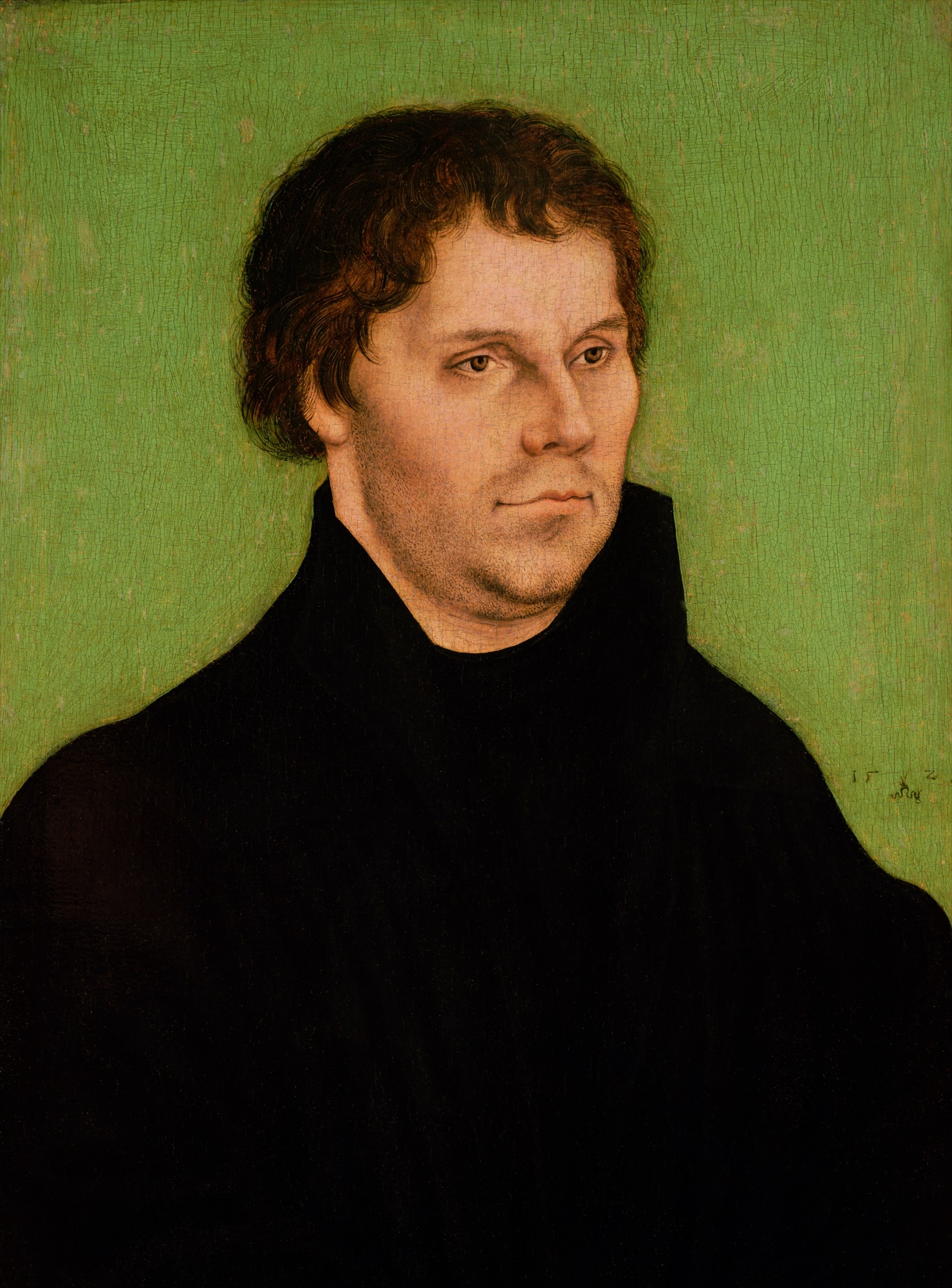
“The truth of the Gospel is this, that our righteousness comes by faith alone, without the works of the Law. The falsification or corruption of the Gospel is this, that we are justified by faith, but not without the works of the Law. The false apostles preached the Gospel, but they did so with this condition attached to it. The scholastics do the same thing in our day. They say that we must believe in Christ and that faith is the foundation of salvation, but they say that this faith does not justify unless it is ‘formed by love.’ This is not the truth of the Gospel; it is falsehood and pretense. The true Gospel, however, is this: Works or love are not the ornament or perfection of faith; but faith itself is a gift of God, a work of God in our hearts, which justifies us because it takes hold of Christ as the Savior. Human reason has the Law as its object….But faith in its proper function has no other object than Jesus Christ, the Son of God, who was put to death for the sins of the world. It does not look at its love and say: ‘What have I done? Where have I sinned? What have I deserved?’ But it says: ‘What has Christ done? What has He deserved?’ ” Martin Luther, “Lectures on Galatians (1535),” Luther’s Works vol. 26, p. 88
Family is the seed-bed of political community
“For since it is by nature common to all animals that they have a drive to procreate, the first fellowship exists within marriage itself, and the next with one’s children. Then, there is the one house in which everything is shared. Indeed that is the principle of a city and seed-bed, as it were, of a political community. Next there follow bonds between brothers, and then between first cousins and second cousins, who cannot be contained in one house, as if to colonies. Finally there follow marriages and those connections of marriage from which even more relations arise. In such propagation and increase political communities have their origin.” Cicero, On Duties 1. 54. eds. and trans. M.T. Griffin and E.M. Atkins (Cambridge 1991), p. 23.
Luther at the Diet of Worms
“To see excitement and dissension arise because of the Word of God is to me clearly the most joyful aspect of all in these matters. For this is the way, the opportunity, and the result of the Word of God, just as He [Christ] said, ‘I have not come to bring peace, but a sword. For I have come to set a man against his father, etc.’ [Matt. 10:34-35]. Therefore, we ought to think how marvelous and terrible is our God in his counsels, lest by chance what is attempted for settling strife grows rather into an intolerable deluge of evils, if we begin by condemning the Word of God. And concern must be shown lest the reign of this most noble youth, Prince Charles (in whom after God is our great hope), become unhappy and inauspicious. I could illustrate this with abundant examples from Scripture–like Pharaoh, the king of Babylon, and strengthen their kingdoms by the wisest counsels, most surely destroyed themselves. For it is He who takes the wise in their own craftiness [Job 5:13] and overturns mountains before they know it [Job 9:5]. Therefore we must fear God. I do not say these things because there is a need of either my teachings or my warnings for such leaders as you, but because I must not withhold the allegiance which I owe my Germany. With these words I commend myself to your most serene majesty and to your lordships, humbly asking that I not be allowed through the agitation of my enemies, without cause, to be made hateful to you.” Martin Luther, “Luther at the Diet of Worms,” Luther’s Works, vol. 32, pp. 111-112.
This quote comes from Luther’s speech at the Diet of Worms on April 18, 1521. It demonstrates Luther’s audacity based in his trust in Christ and his Word. Additionally, he reminded the princes assembled that he was a loyal German subject of the Holy Roman Empire.
Natural Fellowship
“Perhaps, though, we should examine more thoroughly what are the natural principles of human fellowship and community. First is something that is seen in the fellowship of the entire human race. For its bonding consists of reason and speech, which reconcile men to one another, through teaching, learning, communicating, debating and making judgements, and unite them in a kind of natural fellowship. It is this that most distances us from the nature of other animals.” Cicero, On Duties 1. 50. eds. and trans. M.T. Griffin and E.M. Atkins (Cambridge 1991), p. 21.
Reason and speech unite all humanity in a natural felllowship. By means of these, human beings learn, communicate, and resolve differences. Without reason and speech human beings are close to mere animals.
Wisdom, knowledge, and information
“The Eagle soars in the summit of Heaven,
The Hunter with his dogs pursues his circuit.
O perpetual revolution of configured stars,
O perpetual recurrence of determined seasons,
O world of spring and autumn, birth and dying!
The endless cycle of idea and action,
Endless invention, endless experiment,
Brings knowledge of motion, but not of stillness;
Knowledge of speech, but not of silence;
Knowledge of words, and ignorance of the Word.
All our knowledge brings us nearer to our ignorance,
All our ignorance brings us nearer to death,
But nearness to death no nearer to GOD.
Where is the Life we have lost in living?
Where is the wisdom we have lost in knowledge?
Where is the knowledge we have lost in information?
The cycles of Heaven in twenty centuries
Bring us farther from GOD and nearer to the Dust.”
T.S. Eliot, “Choruses from the ‘The Rock’ ” in The Complete Poems and Plays (New York: Harcourt, Brace & World, 1971), 96.
T.S. Eliot wrote fascinating poetry in the 20th century. Although he was born in St Louis, Missouri, he became a British citizen in 1927 and was a devout Anglican. He won the Nobel Prize for literature in 1948. He wrote “Choruses from the Rock” in 1934.
Luther on Depression and Consolation
“When I’m morose I flee above all from solitude. Christ was himself tempted by Satan when our Lord was alone in the wilderness….in short, spiritual anguish exceeds bodily suffering by far. The anguish of Judas–’you have betrayed innocent blood’–became for him the most awful death.” Martin Luther, “Continuation of the Consolation,” Table Talk no. 3698, Luther’s Works, volume 54, p. 276. [Emphasis added]
Martin Luther believed inner turmoil to be worse than physical suffering. He also encouraged depressed people to seek consolation in the company of friends. However, he also understood the source of spiritual anguish to be a misunderstanding of God’s Word. He continued the quote from above:
“This is especially so when the devil turns the gospel into law. The teachings of the law and gospel are altogether necessary but they must be distinguished even when they are conjoined, otherwise men will despair or become presumptuous.” Ibid.
Luther Discusses Lombard
“Peter Lombard was adequate as a theologian; none has been his equal. He read Hilary, Augustine, Ambrose, Gregory, and also all the councils. He was a great man. If he had by chance come upon the Bible he would no doubt have been the greatest.” Martin Luther, “Judgment Concerning Peter Lombard,” Table Talk no. 192, Luther’s Works, volume 54, p. 26.
As a Lutheran who studies the Middle Ages, this is one of my favorite quotes. Dr. Luther’s statements recorded in Table Talk reflect his ability to be humorous and sarcastic to make a point. Peter Lombard wrote the Sentences in middle of the twelfth century. This book became the most siginificant work of scholastic theology that every theologian studied in great detail. Luther studied and taught Lombard’s Sentences and maintained a respect for Peter Lombard but continued to note Lombard’s lack of real biblical understanding.
“Peter Lombard was a very diligent man with a superior mind. He wrote many excellent things. He would really have been a great doctor of the church if he had given himself wholly and truly to the Holy Scriptures, but he confuses the Scriptures with many useless quotations.” Martin Luther, “Evaluation of Peter Lombard and His Work,” Table Talk no. 3698, Luther’s Works, volume 54, p. 260.
She Has Talent without a Woman’s Weakness
“There are now many honorable ladies who surpass the daughters of Thomas More in all kinds of learning; but among them all the most shining star, not so much for the clarity of her mind as for the splendor of her virtue and her letters, is my mistress, Elizabeth, sister of our King. She so shines forth that, in justly commending her great versatility, my task is not to find something to praise but to find limits to my praising. But I shall write nothing to which I have not been an eye-witness. She had me for a tutor in the Latin and Greek languages for two years…The ornaments of nature and of fortune, gathered together in my most illustrious mistress, are difficult to judge; I hardly know which is to be estimated the higher. Aristotle’s excellence is wholly transfused into her. For in her are contained all beauty, stature, prudence, and industry. She has just passed her sixteenth birthday, and is so grave in age and so gentle in her rank to a degree unheard of. Her study of true faith and of learning is most energetic. She has talent without a women’s weakness, industry with a man’s perseverance, and memory than which I know none quicker to perceive or longer to retain. She speaks in French and Italian as well as she speaks in English; in Latin easily, correctly, and thoughtfully; and she has even spoken with me in Greek tolerably well, frequently, and voluntarily. When she writes in Greek or Latin, nothing is more beautiful than her handwriting. She is skilled in music as she is delighted by it.”
Roger Ascham, “Roger Ascham to Johann Sturm, April 4, 1550,” in The Great Tradition: Classic Readings on What It Means to Be An Educated Human Being, ed. Richard M. Gamble. Wilmington 2007, pp. 434-35.
Roger Ascham (d. 1568) served as Elizabeth’s tutor from 1548 to 1550 and again in 1555 before she became Queen Elizabeth in 1558. Even if we believe that Roger used hyperbole when he described her, Princess Elizabeth was obviously an exceptional student and a person with great intellect.
Studies of Free Individuals
“We call those studies liberal, then, which are worthy of a free [liber] man: they are those through which virtue and wisdom are either practiced or sought, and by which the body or mind is disposed towards all the best things. From this source people customarily seek honor and glory, which for the wise man are the principal rewards of virtue. Just as profit and pleasure are laid down as ends for illiberal intellects, so virtue and glory are goals for the noble.” Piero Paolo Vergerio, “Character and Studies Befitting a Free-Born Youth,” in The Great Tradition: Classic Readings on What It Means to Be An Educated Human Being, ed. Richard M. Gamble. Wilmington 2007, p. 313. [Italics in original]
Vergerio, the great teacher of the early Renaissance, describes the nature of true liberal studies and their purpose. Liberal derived from the Latin word, liber, meaning free. Notice how Vergerio connects virtue and wisdom and identifies them as the goals of true learning. Following classical tradition, Vergerio points out that true virtue and glory are the noble goals to which the liberal person strives through the liberal arts.